
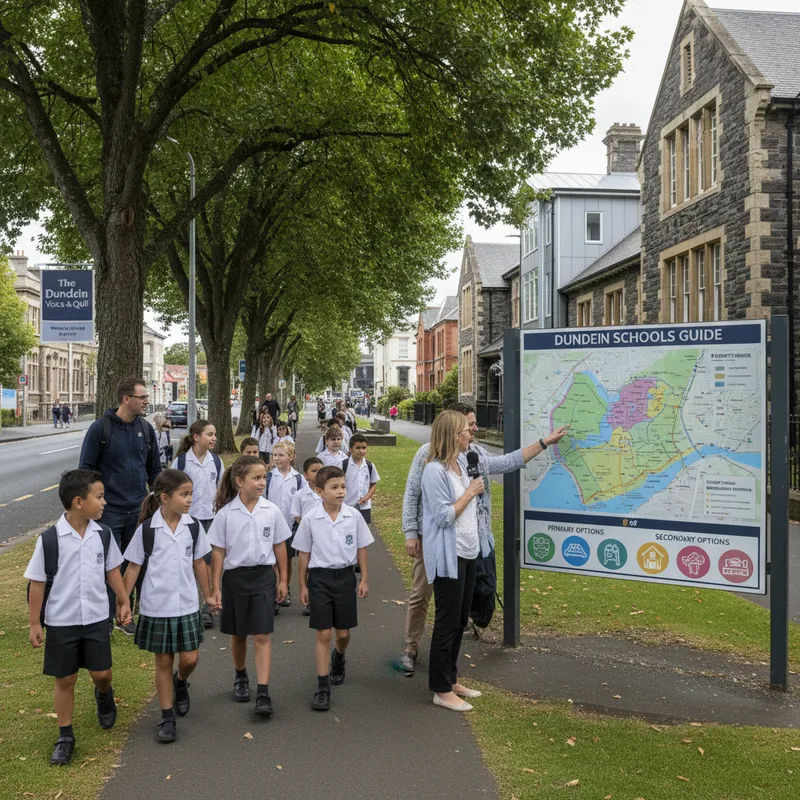
Families moving to Dunedin quickly learn that “choosing a school” is really three decisions rolled into one, where you live, what kind of school culture suits your child, and how to navigate enrolment zones and application timelines. Add in the lingering idea of “deciles” (now replaced by the Equity Index) and it can feel like everyone has an opinion, but the official rules are hard to pin down.
This guide is written for parents and caregivers who want comparative, practical information, without the myths. We explain how zoning works in Dunedin, what the decile system used to mean, what the Equity Index (EQI) means now, where to find reliable school data, and what to ask on a school tour. We also include a suburb-by-suburb way to think about likely school pathways, plus a short list of well-known Dunedin schools and what families tend to choose them for.
How school zones work in Dunedin (and how to check your address)
Many Dunedin state schools operate an enrolment scheme (often called a “school zone”). If your child lives within the school’s home zone, they are guaranteed a place. If you live outside the zone, you can still apply, but acceptance depends on available places after in-zone enrolments are confirmed. That process is controlled by Ministry of Education rules and overseen by school boards.
The official starting point is the Ministry’s guidance on school zones and enrolment schemes, which also explains the out-of-zone process and why you cannot temporarily move into a zone to secure a place. The legislation is clear that enrolments can be annulled if they are based on false information or temporary residence. To check which schools are tied to a given address, use Education Counts’ “Find your nearest school” tool: educationcounts.govt.nz/find-school. You can search by address or by school name. For families house hunting, it is worth checking zones before making an offer, as zones can be street-specific and can cut across suburbs, similar to how Waikato University expands environmental planning studies.
- Practical tip: ask the school office what proof of address they require (typical examples include a tenancy agreement, rates notice, or utility bill).
- Moving later: if you move out of a zone after your child is enrolled, your child can usually stay enrolled at that school.
- Out-of-zone applications: schools must advertise if they have places, and selection is by ballot when applications exceed places.
Deciles vs the Equity Index (EQI): what it really tells you
Decile ratings were historically used in New Zealand to determine equity funding for schools, based on socio-economic indicators of the school community. Decile was never intended as a school quality score, but many families treated it like one.
From 2023, New Zealand replaced deciles with the Equity Index (EQI), which is still used to allocate additional funding, but is designed to be less stigmatising and more precise. The New Zealand Government’s explainer is a good plain-English reference: School zones, reviews and equity funding.
The key point for Dunedin parents is this, EQI is not a measure of school quality. It is a measure of socio-economic factors likely to affect learning outcomes, and therefore a guide to how much additional resourcing a school may receive. You can read the Ministry of Education’s EQI overview here: The Equity Index.
- If you still hear “decile”: people are usually referring to reputation, catchment demographics, or historical perceptions.
- Better comparison tools: look at curriculum fit, wellbeing systems, subject breadth, and ERO reporting.
How to compare Dunedin primary schools (years 1-6 and 1-8)
Dunedin has a wide mix of state primary schools, state-integrated Catholic primaries, and a small number of special character options. The best approach is to compare schools on the things that affect your child day-to-day, rather than a single metric.
Start with logistics. If you are in zone for more than one school, consider walking distance, bus routes, and before and after-school care. If you will be commuting across town, factor in winter weather and traffic pinch points around the one-way system and the harbour.
Then compare learning approach. In Dunedin you will find schools that lean strongly into structured literacy and clear routines, and others known for inquiry learning, play-based junior programmes, strong te reo Māori integration, or outdoor education. Ask to see a junior class in action and request a copy of the school’s latest strategic plan.
Ask about support and extension. For children needing learning support, ask how teacher aides are allocated, whether the school has access to Resource Teachers: Learning and Behaviour (RTLB), and what their process is for ORS-funded students. For extension, ask about reading acceleration, maths extension, and cultural or performing arts opportunities.
- School tour question: “How do you share progress with families, and how often?”
- Practical detail: most Dunedin primary schools operate roughly 9am to 3pm, but bell times vary. Confirm start and finish times before committing to after-school activities.
For ideas on settling into the city with school-aged kids, our sister guide, The ultimate guide: 20+ things to do with kids in Dunedin, is a handy weekend planning list while you get to know neighbourhoods.
How to compare Dunedin intermediate and secondary schools (years 7-13)
Dunedin’s secondary landscape includes co-educational colleges, single-sex schools, and state-integrated options. The right pick often comes down to subject breadth, pastoral care, and the culture around sport, arts, and academic extension.
Subject pathways matter. If your child is leaning toward trades, sciences, arts, languages, or digital tech, ask what is available in Years 11 to 13 and how timetabling works. Some schools can offer broad subject choices but have competitive entry into certain programmes. Others may be smaller but provide strong vocational pathways or wellbeing wraparound.
Pastoral care is not just a buzzword. Ask how the school structures deans, form teachers, guidance counselling, learning support, and attendance follow-up. For many families, this is the difference between “a good school on paper” and the school where their child thrives.
Co-curricular fit is a real factor. Dunedin is sport-mad, but also strong in music and performing arts. If rugby, netball, hockey, rowing, kapa haka, or orchestra is central for your child, ask what a typical weekly training or rehearsal load looks like and how the school manages clashes with assessments.
If sport is high on the family agenda, keep an eye on local fixtures and big-event weekends, and how they impact travel and routines. We have covered the city’s push for major events in pieces like Highlanders make pitch to host Super Round in Dunedin, which gives a sense of the region’s sporting focus.
State, state-integrated, private, kura, and special character: what Dunedin families should know
In Dunedin you will encounter several school types. Here is the quick, practical version of what that means when you are enrolling.
- State schools: free to enrol (no tuition fees), may request voluntary donations, usually zoned in popular areas.
- State-integrated schools: part of the state system but with a “special character” (often Catholic). They can charge attendance dues, and may give preference to students connected to that character.
- Private (independent) schools: set their own fees and admissions policies.
- Kura kaupapa Māori and Māori-medium options: teach primarily in te reo Māori, may draw from wider areas and have their own enrolment criteria.
- Special schools and units: for students with high learning or behavioural needs, usually via formal processes and specialist support.
Costs: state schools commonly ask for donations and charge fees for some activities, camps, and stationery. State-integrated schools generally have compulsory attendance dues (amounts vary by school). For private schools, tuition fees can be significant. Always ask for a written schedule of costs for your year level.
Hours: school offices in Dunedin are typically open weekdays roughly 8.30am to 4pm during term, but this varies. If you are booking tours, avoid peak drop-off and pick-up times.
Which Dunedin suburbs feed into which schools? (A practical way to think about zones)

Because zones are detailed and can change, the safest advice is to confirm your exact address using Education Counts. However, families moving to Dunedin often think in terms of “school pathways” tied to suburbs, then check addresses once they narrow housing options.
Here are some common ways families group their search, along with a reminder to verify zoning street-by-street.
- Central and North Dunedin: often chosen for proximity to the CBD and university precinct, but check zoning carefully due to student housing pockets.
- Maori Hill, Roslyn, Mornington, Belleknowes: popular for hill suburbs and established primary communities, zones can be tight.
- Musselburgh, Tainui, St Clair, St Kilda, Forbury: families weighing beach access and flat cycling routes often start here.
- Andersons Bay, Waverley, Vauxhall: east and harbour-side suburbs where school travel can depend on bus routes.
- Pine Hill, Opoho, Liberton: families seeking a quieter feel, with quick access to town.
For weekend recon while you are doing school tours, Dunedin’s event calendar is a useful “community temperature check”. The Midwinter Carnival is a good example of a family-friendly fixture that draws schools and community groups into the city centre, see our coverage: Dunedin Midwinter Carnival introduces timed sessions to ease.
Shortlist of well-known Dunedin schools (with addresses and what they’re known for)
There is no single “best” school for every child, and reputations can lag behind reality. Still, parents new to Dunedin often hear the same school names repeatedly. Below is a starting shortlist across primary and secondary, with practical enrolment notes. Always confirm zoning, year levels, and current enrolment pressure directly with the school.
Otago Boys’ High School (state, boys, Years 9-13)
Address: 160 Littlebourne Road, Dunedin (Belleknowes area).
Known for: strong sporting culture, long-established traditions, broad NCEA subject pathways.
Enrolment note: has an enrolment scheme, check home zone carefully. For a sense of school culture, see our local reporting: Otago Boys' High School students honour Gallipoli's fallen.
Website: https://www.obhs.school.nz/ (confirm admissions details and zone maps on the school site).
King’s High School (state, boys, Years 9-13)
Address: 270 Bay View Road, Dunedin (St Kilda).
Known for: NCEA and scholarship performance claims, strong sport and academic balance.
Website: https://www.kingshigh.school.nz/ (see enrolment and prospectus pages).
Bayfield High School (state, co-ed, Years 9-13)
Address: 9 Shore Street, Dunedin (Andersons Bay).
Known for: supportive culture, arts and sport options, a mix of academic and vocational pathways.
Enrolment note: check zone, as the harbour-side catchments can be detailed.
Website: https://www.bayfield-high.school.nz/
Columba College (private, girls Years 7-13, co-ed Years 1-6)
Address: 18 Young Street, Dunedin (Roslyn).
Known for: independent-school setting, strong co-curricular, boarding options.
Costs: private school fees apply, request the latest fee schedule from the admissions office.
Website: https://www.columbacollege.school.nz/
John McGlashan College (state-integrated, co-ed, Years 7-13)
Address: 2 Pilkington Street, Dunedin (North East Valley).
Known for: Presbyterian special character, structured pastoral care, smaller-school feel for some families.
Costs: attendance dues apply, ask the school for current amounts.
Website: https://www.jmc.school.nz/
St Hilda’s Collegiate School (private, girls, Years 7-13)
Address: 2 Fulton Road, Dunedin (St Clair).
Known for: independent girls’ education, boarding, strong sport and arts profile.
Costs: private fees apply, request updated tuition and boarding costs.
Website: https://www.sthildas.school.nz/
Examples of Catholic primary options (state-integrated)
Dunedin has several state-integrated Catholic primaries. Families typically consider them for special character and parish connections. Education Counts lists schools in the Dunedin district, including Sacred Heart School (Dunedin) and others: Education Counts, schools in Dunedin district.
Costs: attendance dues apply, vary by school.
Important: We have included addresses and websites to help you start your shortlist, but zoning boundaries and intake pressure can change. Always verify your exact eligibility and timelines with the school office and official tools.
Enrolment timelines, ballots, and what to do if you’re out of zone
If you are moving to Dunedin mid-year or trying to get into a high-demand zoned school, planning matters. Schools usually publish enrolment information, key dates, and out-of-zone ballot processes on their websites and newsletters.
The Ministry of Education explains that schools must follow a specific process for out-of-zone places, and they need to advertise when there are places available. While ballot dates differ by school, out-of-zone advertising often happens around September for the following year, with some schools running multiple intakes. If you are arriving at an unusual time, call the school office early and ask how they handle late-year enrolments.
- Documents: bring proof of address, birth certificate or passport, immunisation record, and any learning support plans.
- Shared care: if caregivers live at two addresses, ask the school what address determines zoning.
- If you miss out: ask to be advised of future ballots and consider your local in-zone school as a secure option.
What to ask on a Dunedin school tour (a checklist you can print)
School tours are where you find out if the “feel” matches the brochure. Take notes, and if possible visit two classes across different year levels.
- Learning: What approach do you use for structured literacy and maths?
- Class size: What are typical class sizes in Years 1-3, 4-6, and 7-10?
- Support: How are learning needs identified and supported, and by whom?
- Extension: What options exist for advanced learners, sport, arts, and leadership?
- Wellbeing: How do you manage bullying, attendance, and pastoral care?
- Digital: What devices are expected, and what do they cost?
- Costs: What are the total likely costs for the year (donations, stationery, camps)?
- Transport: What are the main bus routes, and what is the bike storage like?
If you are new to Dunedin and juggling settling-in stress, it can help to pair school tours with low-key family activities. Our coverage of community wellbeing events, such as Dunedin to host free yoga day for wellness and peace, can be an easy way to meet locals and build routine while you make school decisions.
Where to find reliable data on Dunedin schools (and what to ignore)
Dunedin parents will encounter Facebook threads and anecdotal rankings, which can be useful for generating questions, but should not be your only source. Prioritise official tools and primary documents.
- Education Counts: school profiles and the “Find school” locator: educationcounts.govt.nz/find-school.
- Ministry of Education zoning rules: School zones and enrolment schemes.
- ERO reports: use the Education Review Office to read review reports for schools you are considering: ero.govt.nz.
- Equity Index explainer: Govt.nz school zones and EQI.
What to ignore: simplistic “best school” lists that do not explain methodology, or which treat decile as a quality score. If you see a claim about performance, ask the school what data it is based on and whether it relates to NCEA, attendance, or value-add measures.