An award-winning Northland poetry collection has been launched in Dunedin.
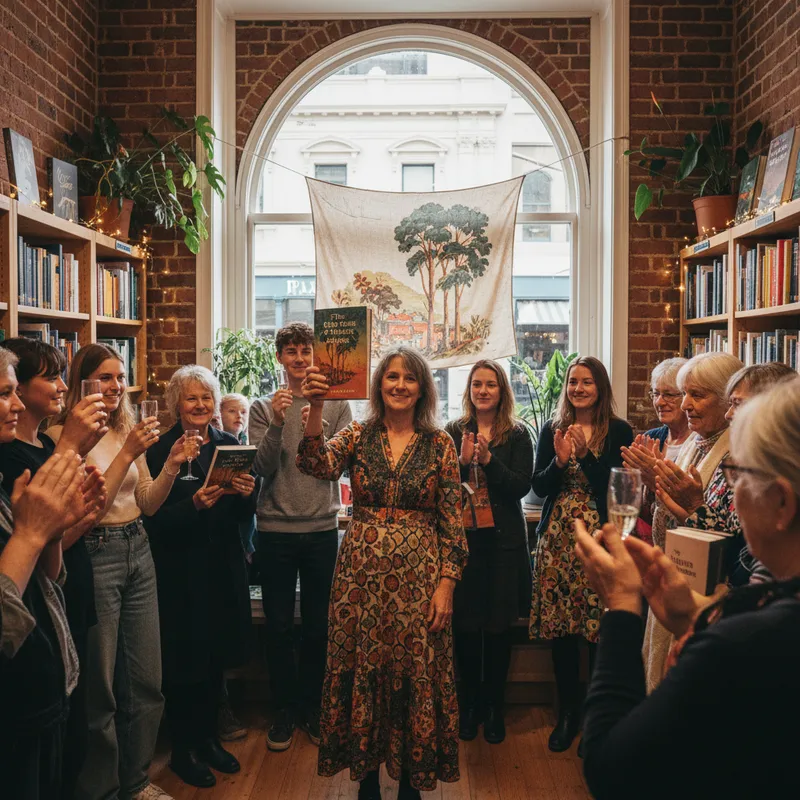
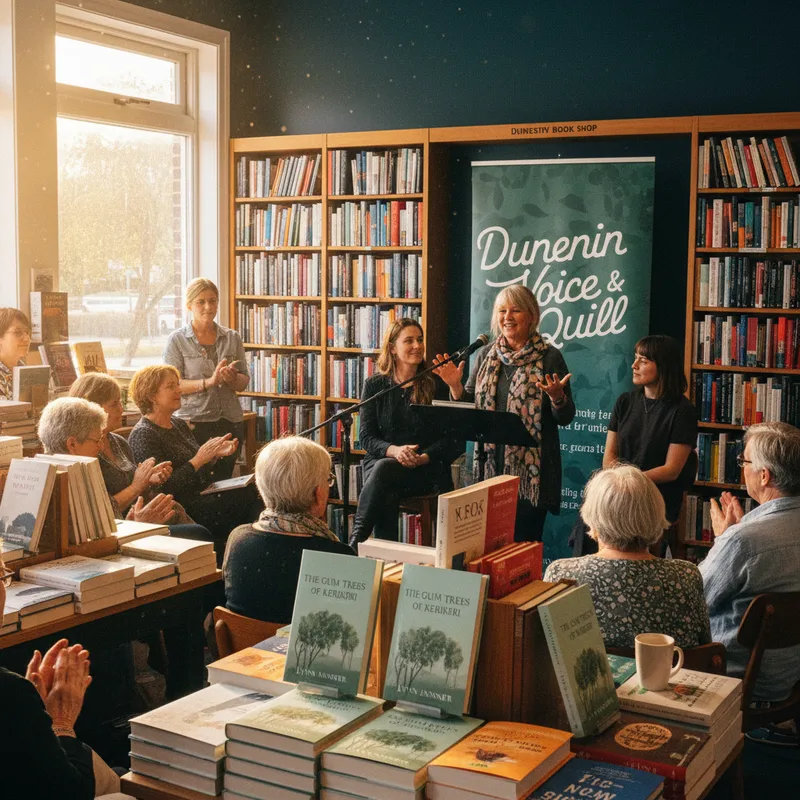
Writer Lynn Jenner’s The Gum Trees of Kerikeri was celebrated at the University Book Shop in Ōtepoti on Thursday, March 19.
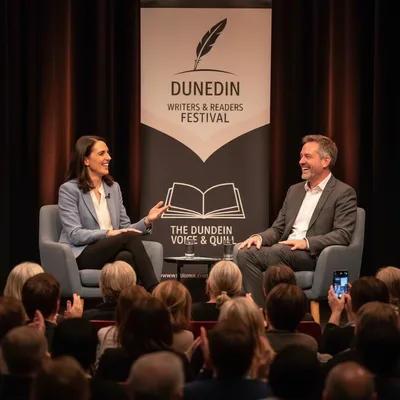
The evening brought Jenner together with poet and critic David Eggleton, who delivered the launch speech, and publisher Sue Wootton. The book was chosen by Poet Laureate Chris Tse for the 2025 Kathleen Grattan Poetry Award.
What happened at the university book shop launch in ōtepoti
Eggleton opened with a greeting and framed the book as a work that looks outward rather than inward. He quoted Russian poet Osip Mandelstam: “My desire is not to speak about myself but to track down the age, the noise, the germination of time,” and said he saw “something of the same impulse” in Jenner’s poems.
He told the audience Jenner began the sequence of untitled poems in 2024, writing from her home in Te Tai Tokerau. “I had started to think about them as more than just tall and beautiful – I was starting to see the, as symbols, remnants of ideas about landscape that were current in this area in the 1920s and 30s”.
Gum trees sit at the centre of the collection, but Eggleton said the book also returns to themes from Jenner’s earlier work, including her essay-memoir Peat about poet and philanthropist Charles Brasch.
Why 'the gum trees of kerikeri' won the kathleen grattan poetry award
Eggleton described Te Tai Tokerau as “a zone of consciousness or associations” in the book, as well as a physical place. He presented the poems as “a carefully crafted recital of histories, legacies and archeologies” that points to “the present and the future”.
Humour runs close to the surface, he said, even when the poems deal with hard subjects. He called it “a wry response to the human condition and its inherent absurdity”.
He read from Poem 6, which pulls dream, memory and place into a single scene: “Charles Brasch once saw a steam engine in a dream; she was his mother: she came from nowhere; crossed the road and went back to nowhere; as we walked the trail through the ginger, the jasmine and the gorse, I heard a heavy engine behind me and I turned, half-hoping that I would see a stylish diesel locomotive grinding up the hill. But there was no train.”
What the poems say about activism, war and 'permacrisis'
One of the clearest ways the collection moves between the personal and the political is through public protest. Eggleton quoted the opening of Poem 12, set at a roundabout on Highway 10: “Standing on the roundabout on Highway 10 on a Saturday morning, waving our “Stop the Genocide” and our “Free Palestine” flags, the 25 of us are a bit of a spectacle … Nearly half the drivers toot their horn and wave; the occasional person gives us the finger, the thumbs down, or a gesture that says we are crazy, but lots of the drivers and passengers and all the dogs just look. They open their eyes wide and stare at us for the whole time it takes to go around the roundabout and pass by…”
Eggleton said Jenner’s method could “admit practically anything for contemplation”, from domestic objects to natural processes. “attention itself is a form of tenderness.” he said, quoting Poem 46.
Standing on the roundabout on Highway 10 on a Saturday morning, waving our “Stop the Genocide” and our “Free Palestine” flags, the 25 of us are a bit of a spectacle … Nearly half the drivers toot their horn and wave; the occasional person gives us the finger, the thumbs down, or a gesture that says we are crazy, but lots of the drivers and passengers and all the dogs just look. They open their eyes wide and stare at us for the whole time it takes to go around the roundabout and pass by…
He listed the images that recur across the sequence: gum leaves, a lone kahikatea, kauri dieback, a space station passing overhead, and the ring of a Tibetan bowl. He said the poems connect “the local to the global”, and he named pressures the book engages with, including “the war in Ukraine, species extinction, climate change, neo-colonialism and so on”.
Eggleton described the effect as an account of contemporary “permacrisis”, where “everything seems in a state of crisis”. For context on kauri dieback, the Department of Conservation’s kauri dieback information outlines hygiene measures and why the disease is hard to contain.
Where gum trees meet northland history and kerikeri landmarks
Eggleton read Poem 25’s question about art-making in troubled times: “What use are romance novels, murder mysteries, poetry about trees, short stories about toxic relationships, and eco-projects in welthy neighbourhoods in a situation like this?”
He said the poems still carry “hopefulness and optimism”, and he quoted Poem 18’s brief bird image: “A second kōtare flew fast and low through the trees, its wings bright blue; there was a flash of feathers on the branch near us and then they were both gone.”
Landscape, he said, is never fixed in the book. “Landscape is multi-layered, a palimpsest,” and the poems hold “absences and of erased narratives.”
In Poem 48, he quoted a moment between two Kerikeri landmarks: “Between the Stone Store and the grassy hill of Kororipo Pā I hear footsteps on the old wooden bridge, but when I look there is only a perfect inlet, parked cars and a Heritage New Zealand plaque.”
When and where the kerikeri launch is happening next
Eggleton positioned the poems as a way to “slow down” and to turn away, briefly, from “over-active electronic devices”. He described Jenner as “a careful recorder” whose “watchfulness is a form of witness, a form of resistance, a form of activism”.
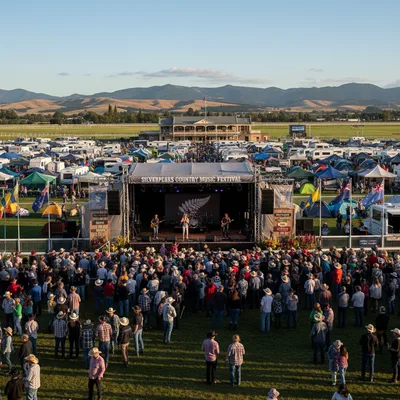
The Dunedin launch comes as Ōtepoti’s arts calendar continues to stack up, from literary events to large public festivals. Recent crowds at the Strath Taieri A&P show and the city’s festival season show appetite for local gatherings even in tighter economic times.
Another launch for The Gum Trees of Kerikeri is scheduled in Kerikeri on March 29.
For readers weighing study and writing pathways alongside creative work, Victoria’s expanding skills options, including the Free TAFE expansion, has also sharpened debate about how arts and training intersect.