
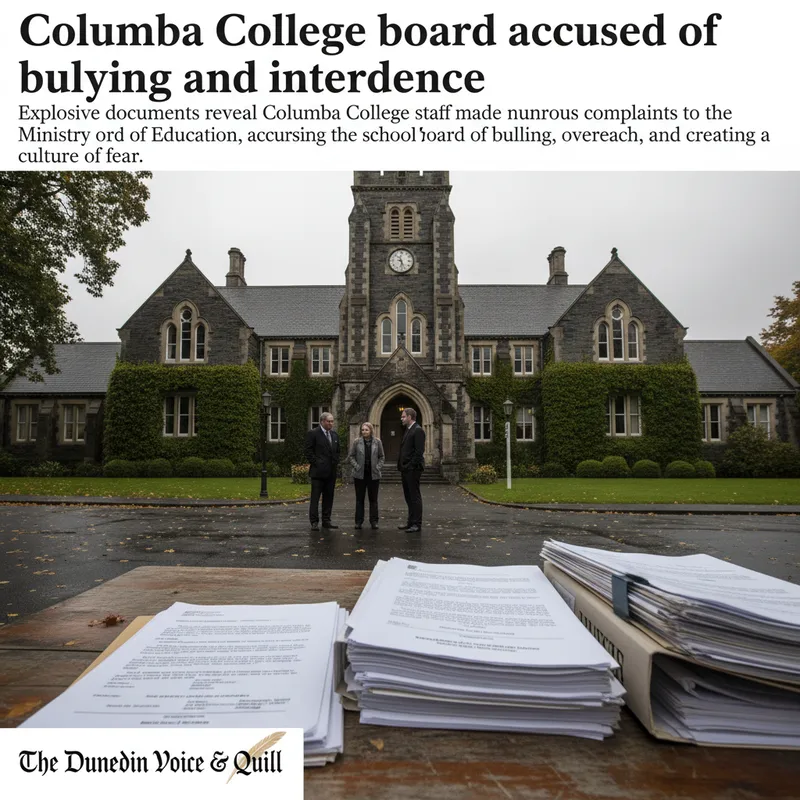
Staff at Dunedin’s Columba College lodged almost 20 complaints with the Ministry of Education last year, accusing the school’s governing boards of bullying, meddling in daily operations, and fostering a "culture of fear," according to documents released under the Official Information Act.
The revelations shed light on a turbulent period at the prestigious girls’ school, which saw the departure of principal Charissa Nicol in October after less than 18 months in the role. The documents, obtained by RNZ, detail a significant breakdown in the relationship between staff and the school’s governance, and a tense standoff with education officials.
In total, 19 complaints were filed with the ministry in 2023. Correspondence from officials to the school’s board summarised the core issue, quoting a complainant who stated the board was "overreaching and interfering with the day-to-day running of the school, as well as not following policies/procedures".
Specific examples cited included the board allegedly breaching policy when investigating a complaint against a teacher, applying undue scrutiny to certain departments, and creating new policies to enforce decisions that would typically fall under school management. The most alarming claim noted by the ministry was that staff were afraid to voice their concerns internally due to a "perceived risk that they would then be targeted by past and current members of the board".
Ministry expresses concern over staff wellbeing
The complaints prompted the Ministry of Education to act, with Judith Forbes, the Dunedin/South Otago manager of integrated services, requesting a meeting with board leaders in April 2023. "I acknowledge that it may be unsettling to hear that the ministry has received such correspondence," she wrote in an email to board presiding member Graeme Riley and then-principal Charissa Nicol.
Following the meeting, Ms Forbes noted the common theme in the complaints was that the boards "may have, over time, developed an unusual degree of involvement in the day-to-day management of the school, and that this may be having a negative impact on the smooth operation of the school and on the wellbeing of its staff". She suggested the board consider conducting a staff wellbeing survey with anonymous responses to gauge the extent of the issue.
The board, however, seemed to view the ministry’s approach as an overreaction. Mr Riley responded that the board felt the complaints should have been referred back to them first. "So this seems like an escalation already, and we are concerned that the Ministry seems to have made decisions about an appropriate process without the benefit of hearing the board’s views or establishing the facts," he said.
We consider progress needs to occur more quickly. Several key governance matters remain unresolved, and the school is clear about the performance expectations that must be met.
Lawyers enlisted as tensions escalate
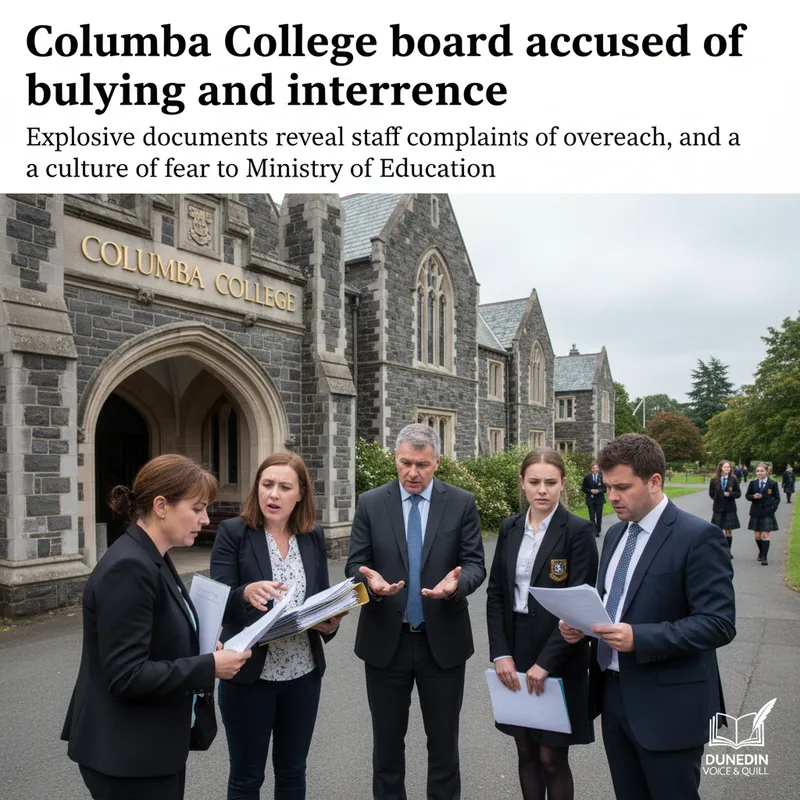
The situation escalated further when the school’s boards engaged law firm Anderson Lloyd. In a letter to the ministry, partner John Farrow said the boards were concerned officials were "forming opinions about the college without providing the information on which those opinions are apparently based". He argued that any consideration of "further action" from the ministry was unwarranted, as the school had already engaged an independent consultant, Cleave Hay, to advise on governance.
Despite the board’s pushback, the ministry’s concerns persisted. In June, Otago central manager Chris Bryant noted in an email that the ministry had heard from several sources about a "significant breakdown in the relationship between the Governance and Management," which raised alarms about the "ongoing operation of the school". When the ministry requested a meeting with the full board, the board’s lawyers again responded, this time accusing officials of potential bias and overreach.
Mr Farrow wrote that the boards considered the ministry’s concerns "not made out on the evidence" and that "the ministry is at risk of overstepping". He added that the board was "concerned those involved at the ministry may not be impartial". This marked a significant escalation, moving from a defence of the board’s actions to a direct challenge of the ministry’s integrity. The ongoing dispute highlights the challenges facing not just a single school, but governance bodies across the country, as Aucklanders face final call on rates hike and service changes in their own civic arena.
An uneasy truce and path forward
A meeting was eventually held in October involving ministry leaders, board representatives, Mr Hay, and lawyers from Anderson Lloyd. Following the meeting, David Tapp, the ministry’s Director of Education for Otago and Southland, sent an email confirming a "fear of retribution" remained a common theme among complainants. While much of the email was redacted, it noted the ministry was keen to see progress on a "well-functioning complaints process which is free from the perception of fear of retribution".
The governance of schools is a complex responsibility, outlined by the New Zealand School Trustees Association (NZSTA), which provides guidelines on the division of roles between boards and school management. Issues like those at Columba often arise when these lines become blurred. For parents navigating the education system, understanding a school's health can be difficult, which is why resources like The Ultimate Dunedin School Guide can be invaluable.
In a recent statement, Mr Tapp said the ministry has seen "improvement" at Columba College since last year. "Columba has taken positive steps since then. We consider progress needs to occur more quickly," he says. "Several key governance matters remain unresolved, and the school is clear about the performance expectations that must be met." He added that while the school is operating effectively day-to-day, the ministry continues to monitor the situation, though further intervention is not currently being considered.
School projects unity after
Historical issues
In a joint statement to RNZ, acting principal Aaron Everett and board member Graeme Riley sought to present a united front, describing their current relationship with the ministry as "highly collaborative and positive". They noted that seven new members had joined the board since last year’s elections and that a working group of staff and board members was meeting regularly.
They framed the OIA release as a "valuable opportunity for transparency and reflection on previous issues," allowing them to address "historical concerns". Regarding the board’s earlier claims about the ministry’s lack of impartiality, the statement asserted that these "historical queries" have been "fully addressed" and that both boards have "complete confidence" in the ministry. This recent turmoil at the school follows other unrelated difficulties for local officials, including an embattled councillor who was recently sanctioned by the Dunedin City Council.
The school’s leadership says it is encouraged by the ministry's confidence in its new direction and is focused on providing the best possible environment for its community. "We welcome their partnership as we strive to provide the best possible environment for our students, staff and wider community," the statement concluded. The school community will be watching closely to see if the recent changes rebuild the trust that was evidently broken.