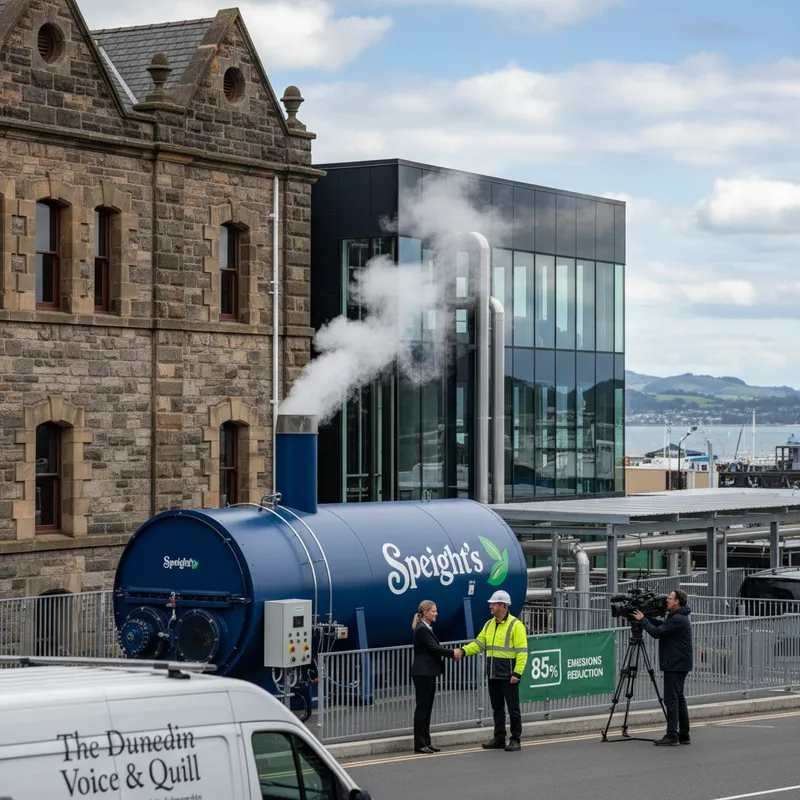
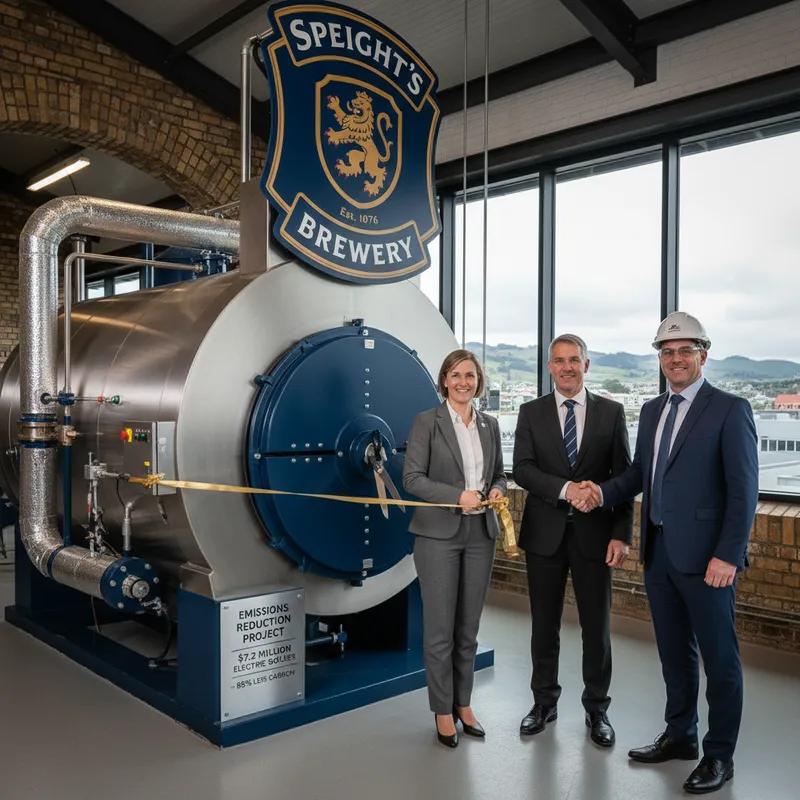
Dunedin’s historic Speight’s Brewery has officially switched to electric power for its brewing process, commissioning a new 3MW electric boiler in a move that will slash the site's carbon emissions and bolster central Dunedin's energy infrastructure. The $7.2 million project, officially unveiled on Wednesday by Dunedin MP Rachel Brooking, marks a significant step in the decarbonisation of one of New Zealand’s most iconic industrial sites.
The new boiler replaces a previous system that ran on Liquid Petroleum Gas (LPG), a fossil fuel. By transitioning to electricity for its steam production, the brewery is set to reduce its greenhouse gas emissions by approximately 708 tonnes annually. Over the boiler's lifespan, this is expected to amount to an 18,500-tonne reduction in CO2-equivalent emissions, representing about 85 per cent of the brewery's total.
The project, first conceived in 2021, has been running in a test phase for the past six weeks, during which Lion's sustainability director, Justin Merrell, noted an immediate drop in the brewery’s emissions. Beyond the environmental benefits, Mr Merrell also pointed to improved workplace safety, as staff will no longer need to handle LPG, and reduced maintenance requirements for the new system.
A major investment in a local icon
Founded in 1876, the Speight’s facility on Rattray Street is New Zealand’s oldest operating brewery and a significant tourist drawcard for the city, complementing other local heritage institutions like the Tūhura Otago Museum. LION, the brewery's owner, views the multi-million dollar investment as a commitment to the site's future and its role in the community.
We are proud to have made a significant investment in New Zealand’s oldest working brewery. Delivered through shared investment with EECA, Aurora Energy and LION, this project is a clear example of our ambition to be a force for good and a force for growth.
The installation was a complex, four-year undertaking that required careful navigation of the brewery's 150-year-old architecture and the historical infrastructure of central Dunedin. This intricate work involved a cross-functional team from LION working alongside national and local partners, including engineering firms Beca and Windsor Engineering, to integrate the modern technology within the heritage site.
Bolstering Dunedin’s energy grid
The benefits of the project extend beyond the brewery walls, contributing to the resilience and capacity of Dunedin's power network. To support the boiler's significant energy requirements, local lines company Aurora Energy undertook a major upgrade, installing 480 metres of new 11kV cable along Rattray Street.
Aurora Energy General Manager Customer and Commercial Services, Mark Pratt, said the upgrade was planned with the city's future needs in mind. "The cable upgrade had the added benefit of improving electricity transfer capacity between Smith St and South City substations and will support future growth and electrification projects in central Dunedin," Mr Pratt says. This infrastructure work helps future-proof the central city for further transitions away from fossil fuels, a key goal for cities nationwide, as regulators grapple with issues like the nation's first ban on large data centers.
The upgrade by Aurora Energy, which also manages the city's streetlight network, is a critical piece of the puzzle, ensuring that large industrial users can switch to electricity without destabilising the grid. It demonstrates a coordinated approach to urban development, where private sustainability initiatives are supported by public infrastructure investment.
A blueprint for industrial collaboration
The project has been praised as a model of public-private partnership, with investment shared between LION, Aurora Energy, and the government’s Energy Efficiency and Conservation Authority (EECA). Meridian Energy also partnered on the project as the electricity retailer.
Paul Bull, EECA’s Manager for Regional & Sector Partnerships, highlighted the collaborative effort as key to the project's success. "From early engagement with EECA, through to securing buy-in and support from Meridian, Aurora Energy, and others – LION has shown real leadership," Mr Bull said. "This was a complex project, and it’s been terrific to see it go from idea to reality."
EECA, which works to help New Zealand businesses lower their carbon footprint, sees the Speight's boiler as an important case study. The successful electrification of process heat in a challenging, historic industrial setting provides valuable lessons and inspiration for other companies considering a similar transition. More information on such government-backed programmes can be found on the EECA website.
The initiative aligns with LION's status as a certified B Corporation, a designation for companies that meet high standards of social and environmental performance, accountability, and transparency. LION reports it has already reduced emissions across its entire operation by 60 per cent. Mr Baldie said projects like the Speight’s boiler "demonstrate our commitment to doing the right thing for the long term."