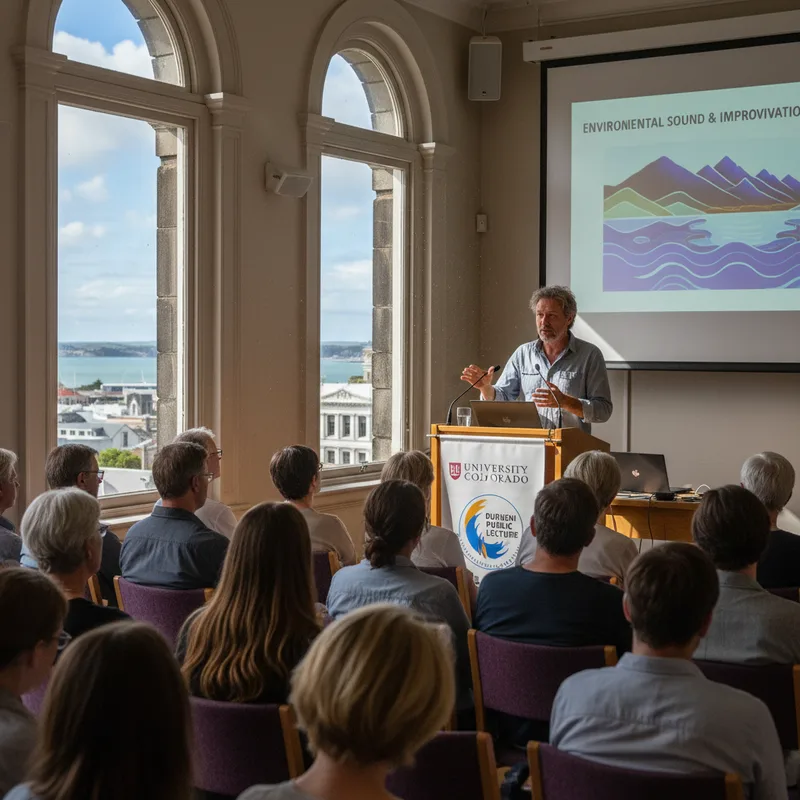
The University of Otago will host American composer and trumpet player Glen Whitehead for a public lecture on the relationship between environmental sound and musical improvisation this March. The event, titled "How we listen and relate sonically to our environment", is scheduled for March 17 at the School of Performing Arts in Dunedin. Whitehead, an associate professor from the University of Colorado, plans to examine how the act of listening to natural surroundings informs creative musical practice. The talk will focus on the specific ties between free improvisation and the technical methods used in field recording. This crossover explores how musicians can respond to and incorporate the sounds of the physical world into their work. The lecture comes as Dunedin institutions increasingly look toward environmental themes in their public programming. The Otago Regional Council is also set to open its own environmental funding rounds around the same date, reflecting a broader regional focus on ecological awareness. Whitehead39s work suggests that art and environmental science often occupy the same space through the medium of sound.
Connecting improvisation and the environment
Whitehead is known for his work in "sonic ecologies", a field that views sound as an interactive part of the natural world. His research often deals with the boundary between intentional composition and the spontaneous noises found in the wild. By recording sounds in various outdoor settings, Whitehead builds a foundation for musical performances that do not follow traditional structures. The talk will likely draw on his experience as a member of the Eco-Acoustic Trio and his collaborations with other experimental artists. These performances often involve the use of the trumpet to mimic or contrast with the acoustic properties of specific locations. It is a method that requires a deep level of concentration on what Whitehead describes as "sonic relations". The School of Performing Arts organisers said the talk is designed for a broad audience, including students and the general public. They noted that the discussion of field recording practices is particularly relevant as technology makes it easier for amateurs and professionals alike to capture high-quality audio in remote locations. This accessibility is changing how people interact with their local geography.
The auditory shift in southern education
The lecture at Te Korokoro o te Tūī represents a growing trend in higher education where arts and environmental studies overlap. University of Otago staff have highlighted the importance of interdisciplinary events that bring international perspectives to the local faculty. Whitehead39s visit follows a series of seminars at the School of Performing Arts aimed at broadening the definition of contemporary music. Other organisations across New Zealand and Australia are seeing similar shifts toward environmental engagement through non-traditional means. In some regions, this manifests through physical activity, such as a free Muay Thai class intended to engage youth with their local parks. In Dunedin, the approach is more academic and auditory, focusing on the mental and creative ways people process the world around them. The timing of Whitehead’s talk coincides with a busy week for the university, following the conclusion of the Classics Programme research seminar and the Biochemistry series earlier in the month. Organisers expect a high turnout from the local arts scene, given Whitehead’s reputation as an experimental musician.
International perspectives on local sound
While Whitehead brings a North American perspective, the issues he raises are pertinent to the Otago region. The unique acoustic properties of the South Island’s coasts and forests provide a different backdrop for field recording than the mountainous regions of Colorado. Attendees at the talk will be encouraged to think about how they perceive the sounds of Dunedin, from the harbour to the city’s urban noise. This focus on local engagement mirrors efforts in the tourism sector, such as a Queenstown operator working to bridge the gap between environmental talk and actual practice. For Whitehead, the bridge is the act of listening itself. He argues that by refining our ability to hear the environment, we become more aware of our place within it. The event is free to attend and will run for one hour, including time for questions from the audience. Organisers have advised that no prior musical training is necessary to follow the lecture. It is part of the university39s commitment to providing accessible public education that links global research with local interests. The lecture begins at 5:30pm on Tuesday, March 17, at Te Korokoro o te Tūī on Union Street East. Attendees do not need to book in advance. The School of Performing Arts will publish updates regarding any related workshops on their official website.