
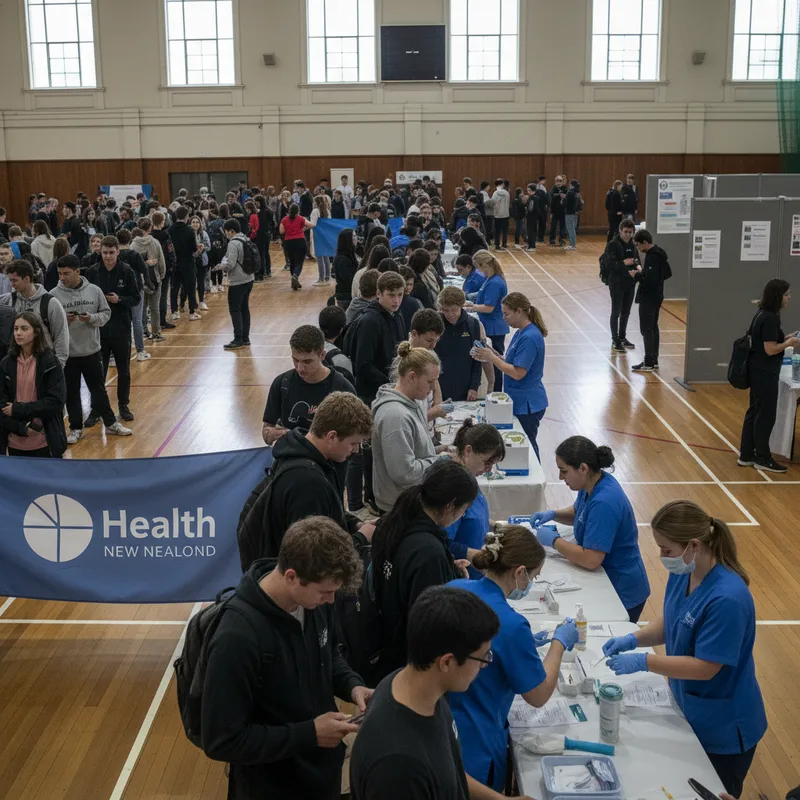
Health New Zealand/Te Whatu Ora is treating meningococcal disease as an outbreak among Dunedin students after two confirmed cases this month, with urgent advice for young people in halls and hostels to get vaccinated and avoid sharing drink bottles or vapes.
The first case was detected at Otago Polytechnic’s Te Pā Tauira hall on 7 March, followed by a second confirmed case this past week at the University of Otago. Health officials suspect there has been at least one other case that has not yet been identified and are warning the infection may be spreading asymptomatically within the student community.
What officials are saying
National Public Health Service medical officer of health Dr John Eastwood said meningococcal bacteria can spread easily through close contact, including in shared accommodation and social settings.
“You can carry it in your nose and throat without having any symptoms, and still pass it on,” he said.
Eastwood urged students, particularly those in residential colleges and hostels, to get vaccinated promptly and to limit behaviours that can facilitate transmission.
Where the cases occurred and who is most at risk
Health New Zealand has confirmed a case at Otago Polytechnic’s Te Pā Tauira and a separate case at the University of Otago. While investigations are ongoing, the agency is treating the situation as an outbreak in the city’s student population. People in shared living, those with frequent close contact, and anyone exposed to respiratory droplets are considered at higher risk.
The public health team is working with tertiary providers, Student Health services and local pharmacies to support vaccination and rapid assessment for anyone who becomes unwell.
Vaccine demand strains pharmacies; more stock due
A weekend surge in demand for meningococcal vaccines saw some Dunedin pharmacies temporarily run out of stock, and students described full clinics and lengthy booking delays. “A lot of places are fully booked for the next two or three weeks,” student Giann van Hwerden said.
Local supply pressures were compounded by the limited number of pharmacies open over the weekend. Health New Zealand says more doses are expected to arrive during the coming week and there is no national shortage of vaccines.
Why strain B matters — and waning immunity
Eastwood said the meningococcal B strain is unique to New Zealand and requires a specific vaccine, which is commonly given in childhood. However, immunity diminishes over time, meaning teenagers and young adults who had their shots years ago may no longer be protected.
“The vaccine only gives protection for about five to seven years — it’s not lifelong,” he said.
Health officials are encouraging students to check their vaccination history and consider a booster if eligible, particularly those living in communal settings or frequently socialising in close quarters.
Symptoms: act fast if you’re worried
Health New Zealand lists common symptoms as severe headache, neck stiffness, sensitivity to light, fever, nausea, drowsiness and a rash. Even with prompt treatment, the disease can be deadly; officials say around one in 10 people infected will die.
Anyone who develops these symptoms, or feels rapidly worse with flu-like illness, should seek urgent medical attention. If it’s an emergency, call 111.
Calls for broader teen coverage
Meningitis Foundation spokesperson Gerard Rushton said the current situation highlights gaps in teen vaccine access. “We’ve been calling for free vaccinations for all teens, not just those in first year halls or boarding schools,” he said.
Rushton, who lost his daughter Courtenay to meningococcal disease in 2014, said the illness can overwhelm healthy young people very quickly. “It can take young people within 24 hours,” he said.
By the numbers — and why dunedin is on alert
There were 40 meningococcal cases across New Zealand last year, including four deaths, health authorities say. While two confirmed cases in Dunedin may sound small, public health specialists treat any cluster in a high-contact community as potentially significant, particularly in the early academic year when students are settling into shared accommodation and social routines.
Outbreak management typically includes rapid contact tracing, targeted prophylactic antibiotics for close contacts where appropriate, and vaccination campaigns geared to the populations most at risk. Those measures are being enacted in Dunedin while laboratories work to confirm the subtype involved in each case and to check for any epidemiological links.
Student calendars, crowded venues and community events
Public health advice about close-contact infections often ramps up in autumn as campuses fill and events pack the diary. In Dunedin, the cultural calendar is already busy — the Dunedin Fringe Festival opens with 91 events scheduled, while the South Dunedin Street Festival is drawing families into shared spaces, and Wild Dunedin reveals 200-event programme for April.
Health officials are not advising against attending events, but they emphasise sensible precautions: stay home if you’re unwell, avoid sharing drinks or vapes, and seek help promptly if symptoms emerge. The timing also explains why pharmacies and Student Health services are experiencing acute demand as students act quickly to update vaccinations.
Elsewhere in the region and across the Tasman, community health, sport and performance initiatives are also drawing interest; in Canberra, an AIS info session drew 50 for the Podium Project, underlining how young people are engaging with wellbeing and performance services.
What students and families can do now
Health New Zealand urges anyone in shared living or frequent close contact to consider vaccination if eligible, and to minimise behaviours that raise transmission risk: don’t share drinks, vapes or utensils, and maintain good hygiene. Students concerned about their vaccination status should contact their GP, Student Health or participating pharmacies to discuss options and availability. If appointments are booked out now, more vaccine stock is expected to arrive in the coming week.
Parents and whānau are encouraged to check in with students about symptoms and care plans, particularly those new to communal living. If in doubt, seek medical advice — early intervention can be life‑saving with meningococcal disease.
How outbreaks are declared — and why this one matters
Declaring an outbreak allows public health teams to coordinate a stronger, faster response, including enhanced surveillance and vaccination outreach within the most affected communities. In student cities like Dunedin, where thousands of young adults share flats, halls and lecture theatres, the conditions for respiratory bacteria to spread are well established.
That does not mean every social venue poses a risk, nor that classes should be avoided. It does mean students should stay alert to symptoms, reduce sharing of items that contact the mouth, and be proactive about immunisation status — especially given waning protection over time from childhood courses against strain B.
Local perspective amid a busy otago calendar
Otago’s packed events season brings visitors and energy to the city — from the Dunedin Fringe Festival to outdoor events celebrating nature and sport. As communities gather, recent stories such as the record participation for New Zealand’s adaptive trail running series show how health, inclusion and public life intersect. Public health officials say sensible precautions can keep that momentum going safely, even as they move quickly to contain the current meningococcal cases.
The bottom line
Two confirmed meningococcal cases in Dunedin’s student community — and the likelihood of at least one more to be identified — have prompted health authorities to declare an outbreak and push vaccination. Short‑term local vaccine shortages are easing, with more doses due. Anyone feeling acutely unwell with symptoms such as severe headache, neck stiffness, light sensitivity, fever, nausea, drowsiness or a rash should seek urgent medical care.