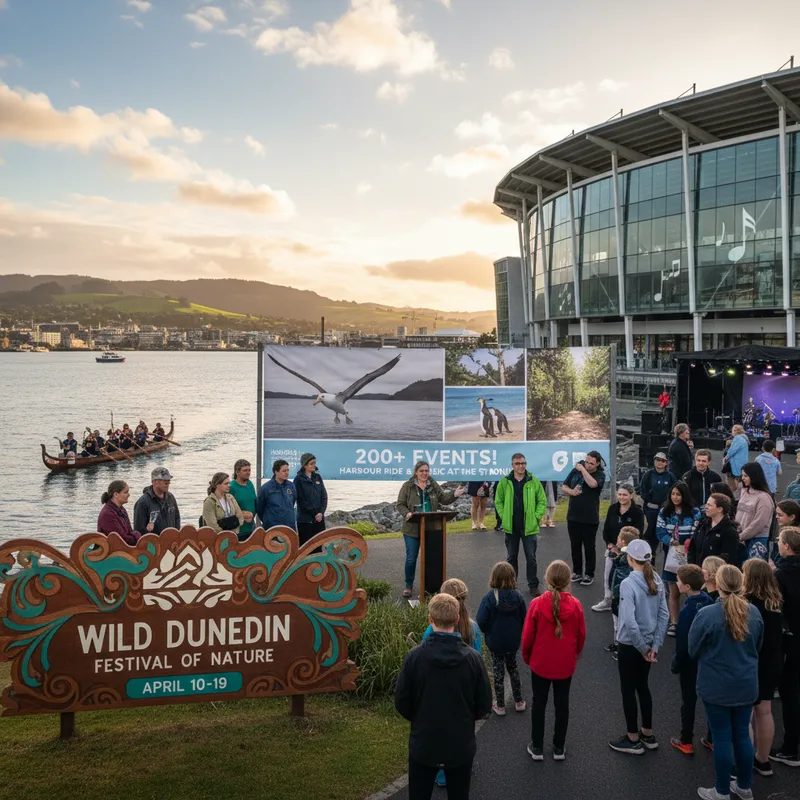
Organisers of the Wild Dunedin Festival of Nature have released a programme featuring more than 200 events for next month's celebration of biology and conservation. Now in its 11th year, the festival spans ten days from April 10 to 19 and expects to draw crowds similar to the 30,000 people who attended in 2025. Festival director Carla Munro says the event aims to showcase the diversity of experiences available in the region's natural environment. The schedule includes a mix of large-scale public gatherings and small, specialised workshops focused on the local ecosystem and scientific research. A major addition to the 2026 calendar is the Wild Ride on April 19. This event encourages participants to explore Te Aka Ōtākou, the harbour pathway that connects Port Chalmers and Portobello. Science activities and educational displays will be stationed along the route, with dedicated ferry services running between the two ports to assist travel throughout the day.
Stadium to host central exhibitions and music
Many of the festival's flagship activities will be held at Forsyth Barr Stadium. The venue will host NatureDome, a large-scale event featuring hands-on science displays, food trucks, and a sustainable market. This centralises several conservation groups and businesses into a single indoor space for families and visitors. Music will also play a role in the stadium's lineup through an event called Pitch Choir. Organisers are inviting the public to join in a mass sing-along of the song Nature, originally by Fourmyula and later made famous by The Mutton Birds. The session will end with a live performance by Don McGlashan on the stadium turf. The focus on the stadium as a primary venue mirrors the city’s recent efforts to utilise major infrastructure for public events. This includes the Dunedin City Council stormwater upgrades and other long-term projects designed to make the city’s low-lying areas more resilient to the elements.
Conservation through education and art
Beyond the music and cycling, the programme lists a variety of technical workshops and guided tours. These are hosted by a range of local organisations, scientists, and community groups. Topics include wild dining experiences that use local ingredients and deep dives into the flora and fauna of the Otago Peninsula. The intersection of art and environment is a repeating theme for the year. This follows other recent city events, such as the talk on environmental sound by an American composer. These sessions often look at how people perceive and interact with the natural world through different mediums. Festival trust member and co-founder Kerry Buchan says the initiative has evolved significantly since its inception. What started as a local project has grown in scale. Buchan says the event has now become New Zealand’s festival of nature.
Funding and regional support
Maintaining a programme of over 200 events requires significant cooperation between local government and non-profit sectors. Many of the participating groups rely on regional support to fund their environmental work throughout the year. For instance, the Otago Regional Council ECO Fund provides a path for groups to secure money for conservation projects that align with the festival’s goals. The economic impact of the festival is also a factor for local businesses according to the Dunedin City Council. With 30,000 attendees expected, hotels and eateries often see a boost during the April period. This mirrors the success of other regional events such as the inaugural Hastings Meatball Festival which drew large crowds to its local centre. The full list of activities for the Wild Dunedin Festival of Nature is now available on the official website. Bookings for specific workshops and the Wild Ride ferry services are recommended to be made in advance. The festival concludes on April 19 with the final harbour events and the Don McGlashan performance.